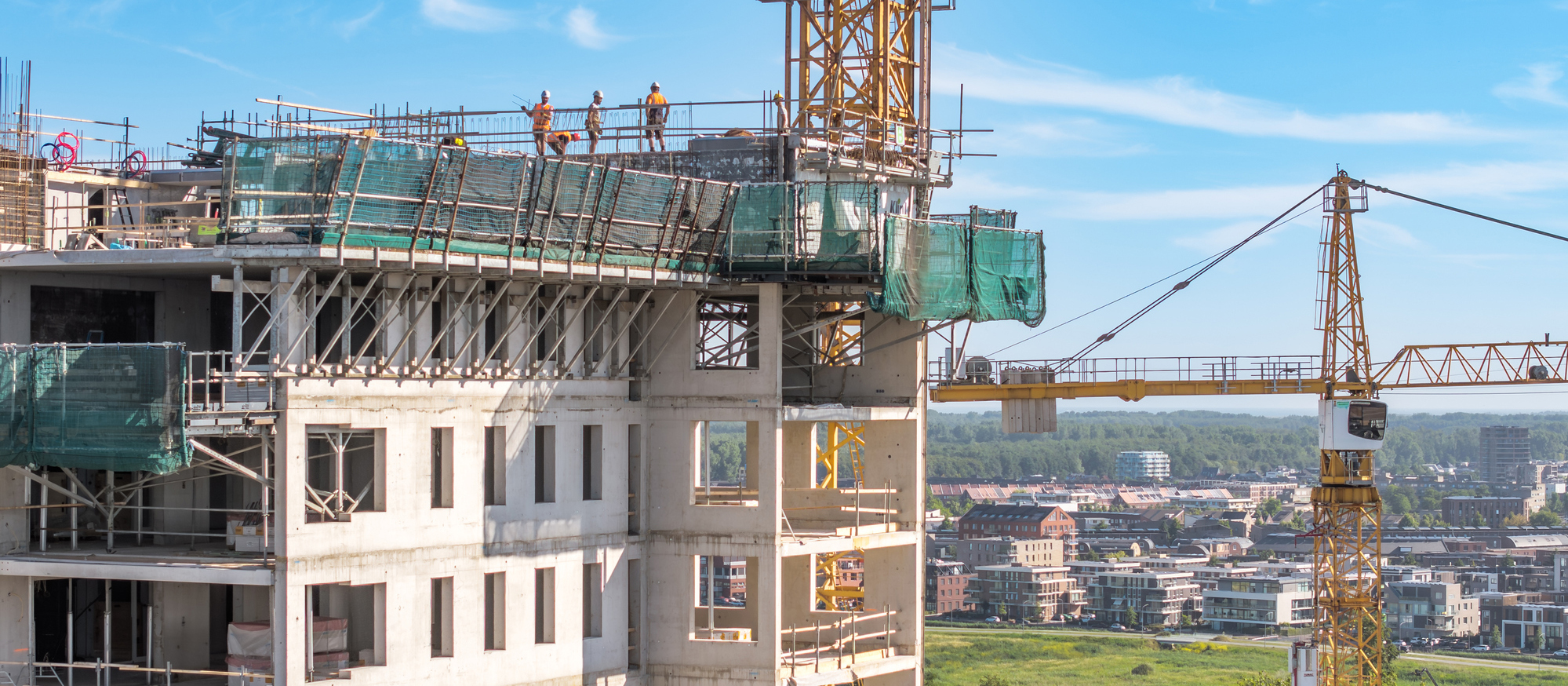
In 2025, a record €5.3 billion was invested in new-build developments. This corresponds to approximately 17,800 new rental homes that can be delivered in the coming years. Whether this momentum will continue in the years ahead remains uncertain. Investments by international parties remain limited, the number of building permits has declined, and market parties continue to face constraints such as local regulations, lengthy permitting procedures and objection processes.
New-build

Investments in new-build rental housing at record high
Investments in new-build rental housing reached a record level of €5.3 billion in 2025. This was largely driven by a strong increase in investments by Dutch institutional investors, who acquired €3.6 billion worth of new-build rental housing. Housing associations invested a further €1.3 billion, with the remainder invested by other market parties. Based on the total capital invested, approximately 17,800 new rental homes are expected to be added to the housing stock in the coming years.
International investors largely absent
Only 7% invested by international investors
A striking feature of the investment volume is the absence of international investors. Only 7% of total transaction volume and just 1% of new-build investments involved an international buyer.
Unattractive investment climate
Since 2023, the investment climate for international investors has become unattractive due to a combination of factors. These include higher capital market interest rates, rent regulation and limits on rent increases, reduced interest deductibility, higher transfer tax and the level of corporate income tax. As a result, investments in Dutch new-build residential projects are less attractive than investments in other countries or alternative asset classes. This is further compounded by relatively low yields and the fact that, due to forward-funding structures, returns are often only generated after a longer period.
Majority see opportunities for 2026
More than half of the international investors surveyed indicate that they intend to invest in new-build or very recently completed developments in 2026. An important explanation is that all of these investors already hold residential assets in the Netherlands and are therefore familiar with the market. However, they also indicate that investment conditions will need to improve for such investments to materialise.
5151
%increase in investment volume in new construction compared to 2024
11
%share of new-build investments by international investors
Number of building permits declines
Expected decrease of 8,4%
As predicted several years ago, housing construction entered a downturn in 2025. As a result of the low number of building permits issued in 2023, a total of 69,200 new-build homes were completed in 2025. Because more permits were granted in 2024, completions are expected to be substantially higher in 2026, at around 88,400 homes
86.000 building permits in 2025
Whether this higher level of production will continue into 2027 remains uncertain. The number of building permits issued in 2025 amounts to 86,000, representing a decline of 8.4% compared with 2024. In addition, rising mortgage interest rates towards the end of 2025 and early 2026 may affect the sales of new-build homes scheduled for completion in 2027.
In the Primos forecast for new-build developments (completions plus the net balance of other additions and withdrawals), a peak in additions to the housing stock of 98,000 homes is assumed for 2027. Given that the number of building permits issued is too low to support the addition of 98,000 homes in that year, there is a risk that the housing shortage will remain elevated for longer from 2027 onwards, or decline at a slower pace than expected.
Impact investing: from ambition to capital allocation
Institutional investors embed impact objectives into their portfolio strategy
Impact investing in the Dutch residential and healthcare real estate market has evolved from a strategic ambition into a mature and structural component of investment strategies. Whereas previous years focused mainly on positioning and intentions, the emphasis is increasingly shifting towards transactions, concrete capital allocations and the delivery of measurable social impact. Institutional investors in particular have embedded impact objectives into their long-term strategies and explicitly incorporate societal challenges such as affordability, population ageing and age-appropriate housing into their investment decisions. As a result, impact investing is increasingly becoming an integral part of portfolio construction.
Available capital increases
This study shows that market participants collectively have €13.9 billion available for impact investing over the period 2026–2028. This figure is based on investors’ own interpretation of impact investing, as there is no universally applied definition. Investment ambitions supported by this available capital are significantly higher than last year, when approximately €10.3 billion was earmarked for the subsequent three-year period. This increase illustrates the further institutionalisation of impact investing as a fully-fledged investment category.
The majority of the available capital originates from institutional investors. Within the total available capital, €1.2 billion is allocated to investments in healthcare real estate, underlining the growing importance of this segment within impact-driven strategies.
More initiatives within the healthcare and senior housing segments
In 2025, several impact funds launched by institutional investors were specifically aimed at healthcare real estate and senior housing. At the same time, the actual deployment of impact capital remains dependent on the availability of suitable investment opportunities. Development complexity, procedural requirements and sector-specific constraints—particularly in healthcare real estate—limit the speed at which capital can be deployed.
Within the residential investment market, the pathway towards impact investing appears to be taking shape. For 2025, institutional investors indicated that €3.5 billion was available for impact investments and ultimately invested €3.6 billion in new-build developments that same year. A portion of this new-build activity qualifies as impact investing, as 77% of the acquired rental homes fall within the affordable rental housing segment. The further growth of impact investing will largely depend on how effectively the investment climate and the supply of suitable projects can facilitate these ambitions.
Interim status of Dutch housing construction targets
1 million homes will take longer to deliver
Two key targets currently guide the new-build housing programme: the delivery of 980,000 homes by 2030 and, derived from this, the addition of 100,000 homes per year. These targets apply to the period from 2021 to 2030, of which half has now elapsed. The interim outcome is unfavourable: by the end of 2025, approximately 417,000 homes had been added—73,000 fewer than implied by the target. In other words, delivery is running roughly one year of production behind schedule.
The outlook for the target of 100,000 additions per year appears more positive in the near term. The number of permits issued in 2024 seems sufficient to reach 100,000 additions in 2026, particularly when additional supply from transformations, subdivisions and rooftop extensions is taken into account. However, this momentum may prove temporary, as the number of permits issued in 2025 is expected to be lower than in 2024. In the Primos forecast, new-build production (according to the Primos definition) reaches 98,200 homes only in 2027, after which output declines again. If the Primos forecast materialises, the target of delivering 980,000 homes will not be achieved until the course of 2032.
What is needed to deliver more new homes?
In recent years, housing construction has faced obstacles from multiple directions, including PFAS regulations, nitrogen constraints, capacity shortages at municipalities and rising interest rates. At present, market parties, developers and housing associations continue to encounter barriers, such as lengthy permitting procedures, the accumulation of local and national regulations, and objection processes.
The feasibility of new-build rental housing projects is under pressure due to an unfavourable rental policy environment. Partly for this reason, 44% of developers converted new-build programmes from rental to owner-occupied housing in 2025. Increasingly, various market parties also cite grid congestion as a significant constraint. Notably, many of these barriers could be mitigated through policy choices or additional efforts by, among others, municipalities. To increase housing supply, making targeted choices that address these obstacles is therefore essential.
3737
%of Dutch developers expect to change projects with rental homes into owner-occupied homes
6666
%of homes of which realisation has been delayed or cancelled are in the social or mid-priced rental segment
Looking ahead to 2040
Both in the short and the long term, significant efforts are being made to accelerate housing construction and to ensure sufficient development pipeline. In the short term, measures such as the Doorbraak locations approach and the planned introduction of the Strengthening Public Control of Housing Act (Wet Regie op de Volkshuisvesting, hereafter the Regie Act) are expected to influence housing delivery. The Doorbraak approach focuses on resolving bottlenecks at existing (large-scale) sites, while the Regie Act aims, among other things, to shorten objection procedures for spatial planning decisions.
For the longer term, a framework has been outlined in the Draft National Spatial Strategy (Ontwerp Nota Ruimte), which designates 130 new, partly large-scale development locations for the period up to 2050. This provides greater clarity and structure for the long-term development pipeline. Partly as a result of these initiatives, and supported by the expected slowdown in household growth, housing production is projected to structurally exceed household growth towards 2040.
In practice, however, the delivery of sufficient housing depends on a wide range of factors and is not determined by the availability of development sites alone. This study once again shows that efficient permitting procedures, avoiding the accumulation of regulations, resolving grid congestion, maintaining an attractive investment climate, favourable market conditions and the availability of sufficient capital are all prerequisites for plans to be realised in practice. At present, not all of these conditions are met. Whether the housing shortage will actually decline towards 2040 therefore remains far from certain.